
Navigating the Maze of Senior Care: What Families Don’t See Behind the Scenes
Understanding the fragmented system behind senior care—and how to navigate it with clarity
Dale Corpus
2/10/20263 min read
Navigating the Maze of Senior Care: What Families Don't See Behind the Scenes
If you are an adult child trying to help an aging parent navigate the transition to senior living, you have probably asked yourself: “Why is this so complicated?”
You are definitely not alone.
For overwhelmed family caregivers across the San Francisco Bay Area—especially in Contra Costa, Alameda, Santa Clara, San Mateo, San Francisco, Solano, and Napa counties—the journey of senior care can often feel like stepping into a confusing, uncoordinated maze.
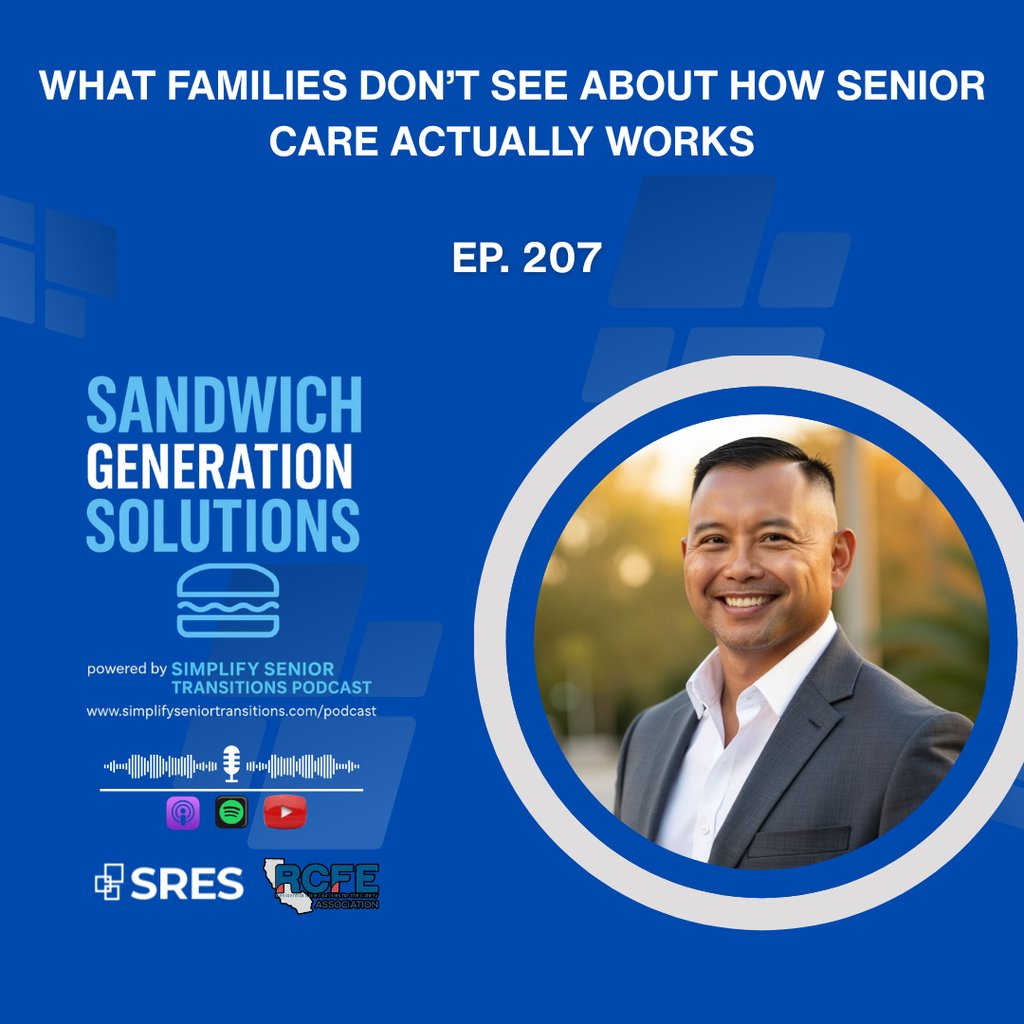
In the latest episode of Sandwich Generation Solutions, powered by the Simplify Senior Transitions Podcast, Bay Area senior transition specialist Dale Corpus pulls back the curtain on how the senior care ecosystem actually works.
If you are feeling the heavy emotional stress of managing a parent's care, this episode is an absolute must-listen.
Here's What You'll Learn in This Episode:
• Why navigating senior care feels so complicated—and why you are absolutely not doing anything wrong
• The hidden truth that senior care is not a single system, but several separate systems operating side by side
• The very different, specific roles that hospitals, rehabilitation centers, and home care agencies play in your parent's journey
• How to approach choosing care options, from independent living to memory care, before a medical crisis forces your hand
• The complex challenges families face when evaluating real estate, including downsizing, home modifications, and selling a senior’s home to fund their long-term care
• Practical tips for managing emotional stress through proactive coordination, financial transparency, and getting siblings perfectly aligned
The Illusion of a Single Senior Care System
One of the biggest surprises for families is realizing that there is no perfectly unified senior care system.
Instead, healthcare, housing, home care, rehabilitation, legal planning, and financial planning all developed independently—each with its own unique rules and timelines.
When an aging parent begins to decline, these entirely separate worlds suddenly intersect. Families unexpectedly find themselves forced to act as the bridge connecting them all.
Understanding the specific incentives of each provider can greatly reduce your frustration.
For example, hospitals are primarily designed to stabilize a sudden medical event, like a fall or a stroke—not to create a long-term care plan. Once your parent is medically stable, the hospital's focus shifts rapidly toward discharge.
From there, they might move to a rehabilitation center, but rehab focuses only on improving strength and function within a limited window of time dictated by insurance.
Home care agencies provide crucial daily support like bathing, dressing, and meal preparation, but they operate strictly on care hours and do not manage big-picture planning.
Ultimately, the overarching question of what long-term living environment will be safest falls directly back onto the family's shoulders.
Choosing Care Options and the Real Estate Hurdle
Eventually, the conversation must shift toward choosing long-term care options, such as independent living, assisted living, or memory care.
These dedicated communities provide essential safety, socialization, and daily support. However, many families wait until a sudden crisis pushes this conversation forward, making the decision process feel rushed and stressful.
This is exactly where housing and real estate enter the picture—an aspect many families do not initially expect.
Your family home must be evaluated to determine whether it is still safe or if it can be modified for mobility issues.
Frequently, the most practical solution is downsizing, or families face the difficult reality that selling the senior’s home is necessary to fund ongoing care.
Handling real estate decisions on top of medical care creates massive pressure, which is why having these conversations early is so important.
Managing Emotional Stress Through Early Coordination
So, how do you manage the emotional stress of piecing this massive puzzle together?
The families who experience the smoothest, most stable transitions share one common trait: proactive coordination.
When professionals communicate clearly, housing options are discussed early, financial planning is transparent, and siblings are aligned, the entire process becomes much calmer.
Decisions become clearer, and the transition feels like a thoughtful plan rather than a chaotic crisis.
Remember, the senior care system was never designed to be perfectly unified.
You are not doing anything wrong if it feels complicated—but with the right guidance and coordination, the process becomes much easier to navigate.
Need Help Navigating a Senior Transition?
When a parent needs care and there’s a home involved, families often have more options than they realize. You don’t have to figure it out alone.
Care Funding Calculator
Estimate how income, assets, and home equity may help pay for senior care:
https://www.simplifyseniortransitions.com/care-funding-calculator
Podcast Episode Library
Browse conversations with senior living experts, elder law attorneys, home care leaders, financial professionals, and families navigating these decisions every day:
https://www.simplifyseniortransitions.com/podcastlibrary
Start Here - Personalized Guidance + Resources
Explore resources, ask questions using the AI Resource Explorer, or connect with Dale directly:
https://www.simplifyseniortransitions.com/starthere
P.S. Got news or an amazing story to share? Hit us up at dale@simplifyseniortransitions.com and you might be featured in our next episode! Remember, always check out the transcript for detailed insights. Happy listening!
Watch The Podcast Here

📞 GET IN TOUCH
📬 STAY INFORMED
Dale Corpus, SRES, RCFE
CA DRE# 01305153 | NMLS# 339169
📱 925-380-1657
© 2026. All rights reserved.
🔎 LEARN MORE



PROUD MEMBER OF