Beyond the Loan: Strategic Alternatives to Reverse Mortgages
Why the best financial strategy for senior care starts with your family's goals—not with choosing a reverse mortgage.
Beyond the Loan: Strategic Alternatives to Reverse Mortgages
Are you an adult child helping an aging parent navigate the complex and often overwhelming world of senior living? If you are an exhausted family caregiver in the San Francisco Bay Area—especially in Contra Costa, Alameda, Santa Clara, San Mateo, San Francisco, Solano, and Napa counties—you are certainly not alone. Managing your parents' future care, housing transitions, and finances can feel like an emotional rollercoaster.
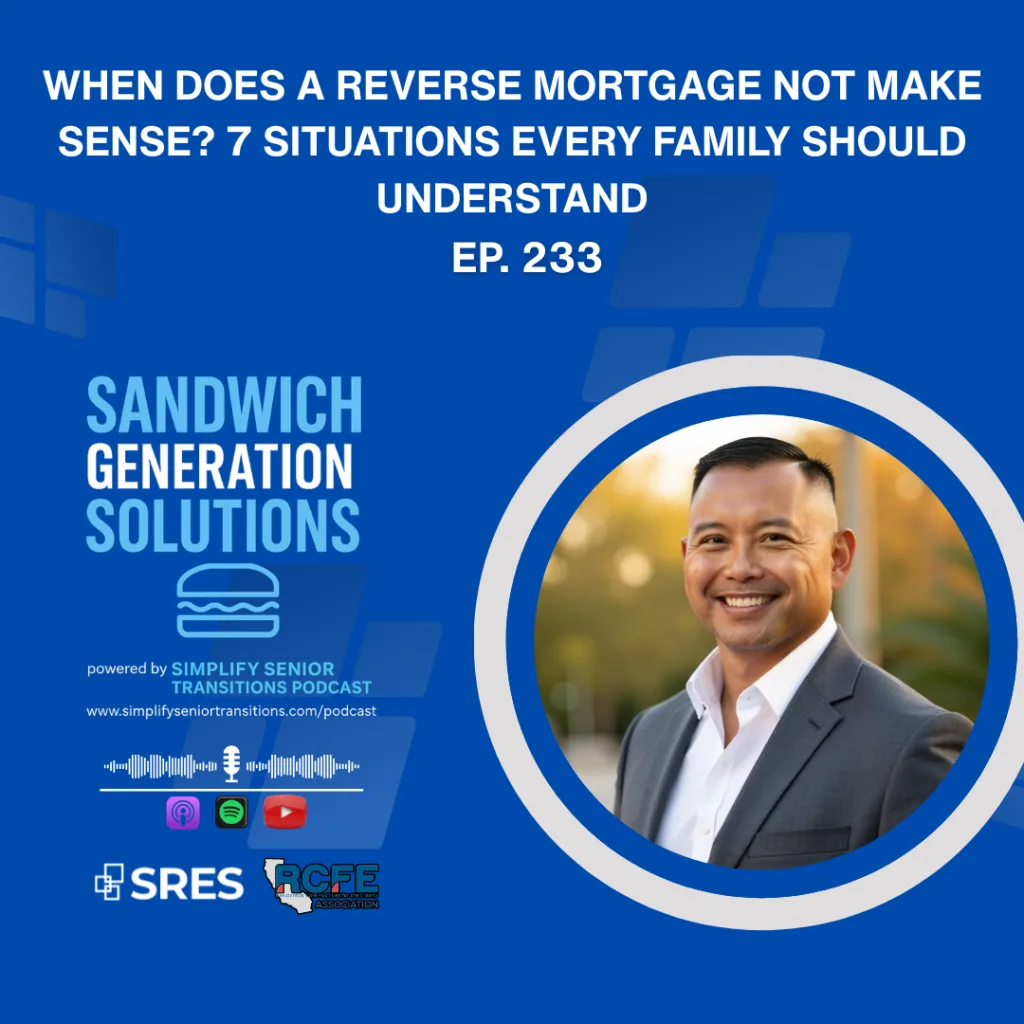
In a recent episode of the Simplify Senior Transitions Podcast, Dale Corpus, a Bay Area Senior Transition Strategist, Realtor, and Reverse Mortgage Specialist, shares a surprising perspective. Even though he provides these loans, he frequently tells families that a reverse mortgage is simply not the right solution.
Key takeaways
- Financing choices should support the family's long-term care and lifestyle goals, not dictate them.
- A reverse mortgage is generally designed for people staying in their home long term, so it is usually a poor fit if a move or downsizing is likely within a couple of years.
- If retirement income, investments, cash flow or long-term care insurance already cover the need, home equity may not need to be touched.
- If a parent needs round-the-clock supervision, a reverse mortgage won't solve the care problem. The care strategy comes first.
Here's What You'll Learn in This Episode
Why a reverse mortgage professional might advise your family against using home equity.
How to properly prioritize your family's unique lifestyle and health goals over financial tools.
The crucial conversations you must have with your parents and siblings before making any housing decisions.
Practical tips for recognizing when aging in place is no longer the safest or most viable option.
Why education and understanding the realities of senior financing must always precede taking action.
Navigating Caregiver Challenges in the Bay Area
Transitioning an aging parent to a new chapter brings up daunting hurdles for adult children. Families often face the physically and emotionally taxing tasks of downsizing decades of accumulated belongings, preparing and selling a senior’s home, and managing the profound emotional stress that inevitably comes with caregiver burnout.
Before you can even figure out how to pay for everything, you must thoughtfully evaluate and choose care options—such as deciding between aging in place, assisted living, or specialized memory care.
When an unexpected crisis hits, like a sudden fall, a hospital stay, or a new dementia diagnosis, families understandably scramble for a quick financial fix to cover soaring costs. However, Dale reminds us that rushing into a product isn't the answer; your financing choices should always support the family's broader, long-term goals, not dictate them.
When Should You Skip the Reverse Mortgage?
Dale breaks down several common scenarios where an alternative strategy makes much more sense for your family.
1. You're Planning to Move or Downsize Soon
Reverse mortgages are generally designed for older adults who want to remain in their current homes long-term. If your parent's plan involves selling the property in the next couple of years to fund a move to senior living or to downsize, a reverse mortgage is likely not the best fit.
2. Existing Financial Resources Can Cover It
Just because a reverse mortgage is an available option doesn't mean it is a necessary one. If your parent has strong retirement income, solid investment accounts, ample cash flow, or long-term care insurance, those resources might already solve the problem without tapping into home equity.
3. Aging in Place Is No Longer the Safest Option
This is often one of the hardest conversations families must have. If a parent requires round-the-clock supervision due to significant medical needs or advanced dementia, keeping them at home might no longer be safe. A reverse mortgage won't magically solve these intensive care needs; the care strategy must always come first.
4. The Family Is Not on the Same Page
It is incredibly common for siblings to disagree on what is best, or for adult children to want something completely different than what their aging parents want. Before looking into any financing tools, everyone must sit down together and find clarity on the primary goal.
5. You Are Looking for a Quick Fix to a Crisis
Many families don't seek help until they are overwhelmed by a crisis, hoping one financial product will solve everything overnight. The best, most sustainable decisions happen when families step back, look at the big picture, and carefully evaluate their housing and care needs together.
Start With the Right Question
Ultimately, the biggest mistake caregivers make is starting the conversation by asking:
"Should we get a reverse mortgage?"
Instead of asking the much more important question:
"What are we actually trying to accomplish?"
Whether your family's goal is reducing caregiver stress, preserving retirement savings, or delaying a move to assisted living, clarifying your true objective makes evaluating your options significantly easier.
Sometimes the answer is a reverse mortgage.
Sometimes selling the home or using another financial strategy makes more sense.
Common Questions
When does a reverse mortgage not make sense?
When your parent plans to sell and move or downsize within the next couple of years, when other resources already cover the cost of care, or when staying at home is no longer safe.
Why would a reverse mortgage specialist advise against one?
Because the loan is a tool, not the goal. Dale frequently tells families it isn't the right solution when it doesn't fit their health, lifestyle and housing plans.
What should families do before choosing any financing?
Agree on the care and housing goals first, talk it through with parents and siblings, and learn how senior financing works before taking action.
Need Help Navigating a Senior Transition?
When a parent needs care and there’s a home involved, families often have more options than they realize. You don’t have to figure it out alone.
Care Funding Calculator
Estimate how income, assets, and home equity may help pay for senior care:
https://www.simplifyseniortransitions.com/care-funding-calculator
Podcast Episode Library
Browse conversations with senior living experts, elder law attorneys, home care leaders, financial professionals, and families navigating these decisions every day:
https://www.simplifyseniortransitions.com/podcastlibrary
Start Here - Personalized Guidance + Resources
Explore resources, ask questions using the AI Resource Explorer, or connect with Dale directly:
https://www.simplifyseniortransitions.com/starthere
P.S. Got news or an amazing story to share? Send it to us through our contact form and you might be featured in our next episode! Remember, always check out the transcript for detailed insights. Happy listening!
Watch The Podcast Here
Watch the episode